High-Speed cards court Switch 2 owners

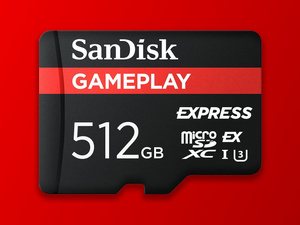
Third‑party accessory brands are already jockeying for search dominance around Nintendo’s unannounced next‑gen hardware, with 512GB microSD Express cards labeled “Switch 2” appearing on Amazon. While Nintendo has not formally detailed the console’s storage interface, the listings signal an anticipatory market narrative: rising install sizes plus an assumed performance uplift create a perceived need for higher‑throughput removable memory from day zero.
MicroSD Express, ratified by the SD Association, layers PCIe and NVMe protocols atop backward-compatible microSD form factors. In theory this catapults maximum sequential read/write ceilings far beyond UHS‑I’s typical ~100 MB/s real‑world plateau. The promise for a hybrid handheld is shorter asset streaming times, faster resume from sleep when pulling data-heavy zones, smoother high-resolution texture fetches, and potentially reduced stalls in open-area traversal—assuming the host device implements the necessary Express-mode controller lanes. Without that host support, the card silently downgrades to legacy speeds, rendering the premium largely moot.
That is the central caveat buyers should internalize right now: seller “Switch 2” taglines are marketing assertions, not validation. Pre‑release ecosystems attract SEO-optimizing descriptions; some will be accurate, others speculative. Prudent consumers may prefer to watch for an eventual Nintendo technical spec sheet or a logo program (similar to “Licensed for Switch” today) that, if updated, could distinguish between baseline UHS‑I and Express-certified performance tiers.
Still, the timing of these listings is instructive. It implies accessory makers are betting on persistent constraints: digital libraries swelling via day‑one patches, multi‑region storefront convenience, and players juggling large first‑party flagships alongside third‑party ports. Switch owners who embraced primarily physical cartridges this generation often supplemented with modest 128–256GB cards; a more robust digital appetite, plus potential 4K‑oriented texture sets (rumored via DLSS-enabled upscaling chatter, unconfirmed), shifts the storage calculus upward.
Cost remains nontrivial. Early microSD Express cards tend to carry a significant cost-per‑gigabyte premium over mature high-endurance UHS‑I options. For some players, buying two conventional 512GB UHS‑I cards and rotating archived titles could beat the experiential gains of a single faster card—particularly if host-side performance differences manifest mostly in edge-case streaming scenarios. The value proposition hinges on actual, benchmarked deltas: cold boot load time reductions, open-world streaming hitch frequency, patch install duration. None of that can be measured until hardware lands.
Thermals are another understated vector. Higher throughput can elevate controller temperature; sustained warm pockets near handheld grip zones might influence ergonomic comfort if the host lacks adequate dissipation. Again—unknown until teardown analyses clarify Nintendo’s storage module placement and airflow or vapor chamber strategy (if any).
For now, the real utility in these listings is psychological prep: they remind prospective purchasers to budget storage alongside the console cost, factoring inevitabilities like multi‑gig seasonal updates and expanding cloud save footprints. Savvy buyers can set price alerts, monitor early adopter benchmarks when the hardware becomes available, and only then commit to Express-tier premiums if empirical gains justify it.
MicroSD Express, ratified by the SD Association, layers PCIe and NVMe protocols atop backward-compatible microSD form factors. In theory this catapults maximum sequential read/write ceilings far beyond UHS‑I’s typical ~100 MB/s real‑world plateau. The promise for a hybrid handheld is shorter asset streaming times, faster resume from sleep when pulling data-heavy zones, smoother high-resolution texture fetches, and potentially reduced stalls in open-area traversal—assuming the host device implements the necessary Express-mode controller lanes. Without that host support, the card silently downgrades to legacy speeds, rendering the premium largely moot.
That is the central caveat buyers should internalize right now: seller “Switch 2” taglines are marketing assertions, not validation. Pre‑release ecosystems attract SEO-optimizing descriptions; some will be accurate, others speculative. Prudent consumers may prefer to watch for an eventual Nintendo technical spec sheet or a logo program (similar to “Licensed for Switch” today) that, if updated, could distinguish between baseline UHS‑I and Express-certified performance tiers.
Still, the timing of these listings is instructive. It implies accessory makers are betting on persistent constraints: digital libraries swelling via day‑one patches, multi‑region storefront convenience, and players juggling large first‑party flagships alongside third‑party ports. Switch owners who embraced primarily physical cartridges this generation often supplemented with modest 128–256GB cards; a more robust digital appetite, plus potential 4K‑oriented texture sets (rumored via DLSS-enabled upscaling chatter, unconfirmed), shifts the storage calculus upward.
Cost remains nontrivial. Early microSD Express cards tend to carry a significant cost-per‑gigabyte premium over mature high-endurance UHS‑I options. For some players, buying two conventional 512GB UHS‑I cards and rotating archived titles could beat the experiential gains of a single faster card—particularly if host-side performance differences manifest mostly in edge-case streaming scenarios. The value proposition hinges on actual, benchmarked deltas: cold boot load time reductions, open-world streaming hitch frequency, patch install duration. None of that can be measured until hardware lands.
Thermals are another understated vector. Higher throughput can elevate controller temperature; sustained warm pockets near handheld grip zones might influence ergonomic comfort if the host lacks adequate dissipation. Again—unknown until teardown analyses clarify Nintendo’s storage module placement and airflow or vapor chamber strategy (if any).
For now, the real utility in these listings is psychological prep: they remind prospective purchasers to budget storage alongside the console cost, factoring inevitabilities like multi‑gig seasonal updates and expanding cloud save footprints. Savvy buyers can set price alerts, monitor early adopter benchmarks when the hardware becomes available, and only then commit to Express-tier premiums if empirical gains justify it.


