AI speeds up production : Junior roles face new pressure

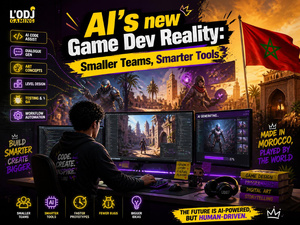
AI is becoming one of the most disruptive forces in game development. Tools that help with code, dialogue, art concepts, level design, testing and workflow automation are giving small teams new powers. A solo developer can now prototype faster, fix bugs more quickly and experiment with ideas that once required a larger team.
A Rest of World investigation highlighted how AI tools are affecting developers in emerging markets, including cases where studios reduced team sizes or shifted work toward AI-assisted production. The story is not that AI magically creates complete games with no human effort. That would be too simple. The real shift is that AI reduces the number of people needed for certain tasks, especially repetitive or entry-level work.
This is where the concern begins. Junior roles have traditionally been the door into the industry. Young developers learn by doing smaller tasks, supporting senior staff and gradually building experience. If studios rely heavily on AI for those same tasks, the first step on the career ladder becomes weaker. That is a serious issue for students, self-taught creators and young professionals trying to break into gaming.
For Morocco, the subject is especially relevant. The country is trying to grow its creative and digital economy, and gaming is increasingly part of that conversation. Moroccan students interested in game design, programming or digital art should not see AI only as a threat. They should see it as a tool they must understand deeply. The future developer will not simply “use AI”; they will know how to direct it, correct it, integrate it and add human taste.
Studios also need to be careful. Games still depend on vision, emotion, pacing, culture, humor, sound and community feedback. AI can accelerate production, but it does not automatically create identity. For Moroccan and African studios, identity may be the strongest advantage: local stories, languages, aesthetics and social realities that generic tools cannot invent authentically.
AI will not end game development. But it is changing who gets hired, what skills matter and how games are built. The smartest move for Morocco’s future creators is to learn the tools without surrendering the human creativity that makes games worth playing.
A Rest of World investigation highlighted how AI tools are affecting developers in emerging markets, including cases where studios reduced team sizes or shifted work toward AI-assisted production. The story is not that AI magically creates complete games with no human effort. That would be too simple. The real shift is that AI reduces the number of people needed for certain tasks, especially repetitive or entry-level work.
This is where the concern begins. Junior roles have traditionally been the door into the industry. Young developers learn by doing smaller tasks, supporting senior staff and gradually building experience. If studios rely heavily on AI for those same tasks, the first step on the career ladder becomes weaker. That is a serious issue for students, self-taught creators and young professionals trying to break into gaming.
For Morocco, the subject is especially relevant. The country is trying to grow its creative and digital economy, and gaming is increasingly part of that conversation. Moroccan students interested in game design, programming or digital art should not see AI only as a threat. They should see it as a tool they must understand deeply. The future developer will not simply “use AI”; they will know how to direct it, correct it, integrate it and add human taste.
Studios also need to be careful. Games still depend on vision, emotion, pacing, culture, humor, sound and community feedback. AI can accelerate production, but it does not automatically create identity. For Moroccan and African studios, identity may be the strongest advantage: local stories, languages, aesthetics and social realities that generic tools cannot invent authentically.
AI will not end game development. But it is changing who gets hired, what skills matter and how games are built. The smartest move for Morocco’s future creators is to learn the tools without surrendering the human creativity that makes games worth playing.


