Mobile games are reshaping the audience

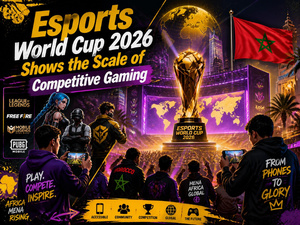
The Esports World Cup 2026 is not just another tournament on the calendar. It is a showcase of how large, polished and international competitive gaming has become. With a reported prize pool reaching tens of millions of dollars and a packed schedule across several major titles, the event is designed to look and feel like a global sports festival.
Audience figures reported by Esports Charts show why the event matters. League of Legends continues to dominate the upper end of global esports viewership, but the strong performance of Free Fire and Mobile Legends: Bang Bang is just as important. These games are not only popular in Southeast Asia and Latin America; they are also deeply relevant across Africa and the MENA region, where mobile gaming is often more accessible than high-end PC or console gaming.
That accessibility is the key. In Morocco, many young players discover competitive gaming through smartphones before moving to PC cafés, consoles or streaming platforms. Free Fire, PUBG Mobile, Mobile Legends and similar titles have built massive communities because they require lower hardware investment and fit naturally into everyday digital life. When these games perform well at a global event, African audiences are no longer just spectators. They are part of the ecosystem.
The Esports World Cup also reflects the growing role of the Gulf in gaming. Saudi Arabia has invested heavily in esports infrastructure, events, teams and publishers. Whether one sees that as ambition, soft power or industrial strategy, the result is clear: the MENA region is no longer peripheral in global gaming conversations.
For Morocco, this creates both opportunity and pressure. Moroccan players and teams can gain visibility through regional circuits, qualifiers and content creation. But to compete seriously, local esports needs structure: coaching, stable organizations, sponsorship, tournament integrity and media coverage that treats esports as more than a weekend hobby.
The biggest takeaway from the Esports World Cup is that esports is becoming more global, more professional and more mobile. That matters enormously for Africa. The next wave of competitive gaming talent may not come only from expensive gaming rooms, it may come from phones, cafés and communities that have been underestimated for years.
Audience figures reported by Esports Charts show why the event matters. League of Legends continues to dominate the upper end of global esports viewership, but the strong performance of Free Fire and Mobile Legends: Bang Bang is just as important. These games are not only popular in Southeast Asia and Latin America; they are also deeply relevant across Africa and the MENA region, where mobile gaming is often more accessible than high-end PC or console gaming.
That accessibility is the key. In Morocco, many young players discover competitive gaming through smartphones before moving to PC cafés, consoles or streaming platforms. Free Fire, PUBG Mobile, Mobile Legends and similar titles have built massive communities because they require lower hardware investment and fit naturally into everyday digital life. When these games perform well at a global event, African audiences are no longer just spectators. They are part of the ecosystem.
The Esports World Cup also reflects the growing role of the Gulf in gaming. Saudi Arabia has invested heavily in esports infrastructure, events, teams and publishers. Whether one sees that as ambition, soft power or industrial strategy, the result is clear: the MENA region is no longer peripheral in global gaming conversations.
For Morocco, this creates both opportunity and pressure. Moroccan players and teams can gain visibility through regional circuits, qualifiers and content creation. But to compete seriously, local esports needs structure: coaching, stable organizations, sponsorship, tournament integrity and media coverage that treats esports as more than a weekend hobby.
The biggest takeaway from the Esports World Cup is that esports is becoming more global, more professional and more mobile. That matters enormously for Africa. The next wave of competitive gaming talent may not come only from expensive gaming rooms, it may come from phones, cafés and communities that have been underestimated for years.


