

 L'accueil

Haunted Chocolatier Screenshot Sparks Speculation

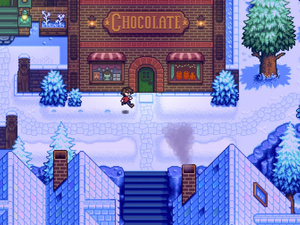
Eric “ConcernedApe” Barone has again shifted the indie spotlight with a deceptively modest reveal: one new Haunted Chocolatier image and a statement that a “popular yet controversial” Stardew Valley mini‑game will be returning in adapted form. Minimal data, maximal ripple. Fans across X (formerly Twitter), Reddit, and Discord have ignited a familiar taxonomy debate—does “controversial” more accurately describe the difficulty spikes of Journey of the Prairie King or the chaotic physics of Junimo Kart? Barone, characteristically, is letting the speculation percolate unconfirmed.
The screenshot itself—soft auric lighting, layered parallax, richer atmospheric particles—extends a visual throughline from Stardew while articulating a moodier palette suited to the quasi‑haunted chocolatier premise. Subtle shadow gradients under static props and a more pronounced emissive glow around interactable objects suggest incremental technical evolution atop the same bespoke C#/XNA-derived foundation (engine details not officially restated, but lineage is consistent).
Reintroducing an internal mini‑game is more than nostalgia. In Stardew, arcade subgames created pacing relief, alternate mastery loops, and a meta layer of bragging rights without fracturing the core farm-sim cadence. Porting or remixing one into Haunted Chocolatier signals a design intent to embed optional skill challenge islands inside a broader comfort loop of crafting, relationships, and exploration. The controversy angle matters because tension (difficulty spikes, leaderboard chasing) can coexist with cozy aesthetics, broadening the experience’s emotional bandwidth.
From a production standpoint, reusing a mechanical skeleton accelerates content density without linearly scaling solo development time. Yet Barone has historically resisted direct asset recycling unless aesthetically justified, so expect revisions: tuned hitboxes, accessibility toggles, or smoother difficulty scaling to address prior criticisms (e.g., punishing early RNG). If the returning mini‑game is Prairie King, for instance, modern concessions could include adjustable enemy wave pacing or optional aim assist; if Junimo Kart, perhaps clearer telegraphing of hazard edges. None of that is confirmed—only plausible given genre standards’ evolution since 2016.
Community reaction splits neatly. One camp applauds continuity as a symbolic handshake to long‑time fans; another worries about perceived creative recursion, desiring wholly new mechanical pillars. The middle ground frames it as an optional garnish—valuable so long as it neither delays core systems (chocolate crafting economy, spectral NPC questlines) nor becomes mandatory for progression gating.
Marketing-wise, the slow-drip reveal cadence preserves mystique. Stardew Valley’s post-launch organic amplification taught an inverse lesson to typical AAA saturation: withholding schedules can prevent fatigue while maintaining baseline social chatter. The risk is expectation inflation. Each micro-tease now bears outsized interpretive weight; deferring a public release window extends a hype half-life that must eventually resolve with substantive gameplay demonstration.
Absent a date, wishlist momentum (when the Steam page eventually materializes) will lean on brand trust. The safest player posture is measured enthusiasm: note the continuity nod, catalog the atmospheric improvements, and wait for a systems-deep dive before extrapolating scope.
The screenshot itself—soft auric lighting, layered parallax, richer atmospheric particles—extends a visual throughline from Stardew while articulating a moodier palette suited to the quasi‑haunted chocolatier premise. Subtle shadow gradients under static props and a more pronounced emissive glow around interactable objects suggest incremental technical evolution atop the same bespoke C#/XNA-derived foundation (engine details not officially restated, but lineage is consistent).
Reintroducing an internal mini‑game is more than nostalgia. In Stardew, arcade subgames created pacing relief, alternate mastery loops, and a meta layer of bragging rights without fracturing the core farm-sim cadence. Porting or remixing one into Haunted Chocolatier signals a design intent to embed optional skill challenge islands inside a broader comfort loop of crafting, relationships, and exploration. The controversy angle matters because tension (difficulty spikes, leaderboard chasing) can coexist with cozy aesthetics, broadening the experience’s emotional bandwidth.
From a production standpoint, reusing a mechanical skeleton accelerates content density without linearly scaling solo development time. Yet Barone has historically resisted direct asset recycling unless aesthetically justified, so expect revisions: tuned hitboxes, accessibility toggles, or smoother difficulty scaling to address prior criticisms (e.g., punishing early RNG). If the returning mini‑game is Prairie King, for instance, modern concessions could include adjustable enemy wave pacing or optional aim assist; if Junimo Kart, perhaps clearer telegraphing of hazard edges. None of that is confirmed—only plausible given genre standards’ evolution since 2016.
Community reaction splits neatly. One camp applauds continuity as a symbolic handshake to long‑time fans; another worries about perceived creative recursion, desiring wholly new mechanical pillars. The middle ground frames it as an optional garnish—valuable so long as it neither delays core systems (chocolate crafting economy, spectral NPC questlines) nor becomes mandatory for progression gating.
Marketing-wise, the slow-drip reveal cadence preserves mystique. Stardew Valley’s post-launch organic amplification taught an inverse lesson to typical AAA saturation: withholding schedules can prevent fatigue while maintaining baseline social chatter. The risk is expectation inflation. Each micro-tease now bears outsized interpretive weight; deferring a public release window extends a hype half-life that must eventually resolve with substantive gameplay demonstration.
Absent a date, wishlist momentum (when the Steam page eventually materializes) will lean on brand trust. The safest player posture is measured enthusiasm: note the continuity nod, catalog the atmospheric improvements, and wait for a systems-deep dive before extrapolating scope.


 Accueil
 Envoyer à un ami
 Version imprimable
 Augmenter la taille du texte
 Diminuer la taille du texte
 Partager